
By Gary Aiken | August 7, 2025
In our Forecast Report, we noted that U.S. stock valuations were at all-time highs. Those high prices reflected the market’s collective belief that certainty about the future was also high. That future certainty included a few important assumptions. If any one of those assumptions fell, U.S. stock prices would certainly decline amid increased vagueness – like unexpected clouds darkening what was supposed to be a clear sky on a sunny day.
Stocks reflected three main assumptions leading into January. First, that revenue and earnings growth would continue apace and maybe even accelerate with lower taxes and less regulation. To be sure, we have seen companies continue to report positive revenue and earnings growth amid a changing political landscape. That has been true for big tech companies, industrial companies, and energy companies so far this quarter.
Second, inflation would continue to moderate and so long-term interest rates could decline. While inflation has not quite moderated, thus far the impacts of tariffs have not bled through. Still, inflation has been sticky above the Fed’s 2% target. At the same time, recent data points to a mildly weaker job market. Short-term interest rates are likely to decline later this year. If short-term rates do not induce significant additional economic growth, long-term rates are likely to decline with them – this is called a “parallel shift” in the yield curve.
Third, no more bad news from the rest of the world. This has been a mixed bag. Israel has defeated all its significant foes, and the Iranian nuclear threat has been removed. While hostages remain in the dungeons of Gaza, the likelihood of externalities for the region and global trade have been reduced to nearly zero. Russia continues to relentlessly bomb Ukraine as Ukraine holds Russia from gaining any additional territory. This stalemate is certainly horrible, but unlikely to involve NATO in a larger conflict. China continues to align itself with America’s enemies and has designs on Taiwan but doesn’t seem to be taking concrete steps beyond its usual provocations.
And so, markets shrugged off the Liberation Day tariff regime as a negotiating ploy, dove headlong into decent earnings growth and received the passing of the One Big Beautiful Bill with applause. In doing so, stocks reached new all-time highs in July. Since stock prices have made a round trip, it’s important to survey where we stand with market assumptions and prices once more.
This month’s chart reviews forward price-to-earnings ratios. Since the market thinks so highly of future earnings, stock prices reflect a willingness to pay dearly for a future that is anything but certain. Technology stock prices are in the 95th percentile relative to their P/E ratios over the past 20 years. While Nvidia and Microsoft are in the news, other sectors find similarly near peak pricing. Consumer Staples, Industrials, and Financials are in the 97th, 95th, and 96th percentile, respectively. Even docile sectors like Utilities reflect prices 91% higher than their relative pricing over the past 20 years.
One Year Forward Price-to-Earnings (P/E) Ratios
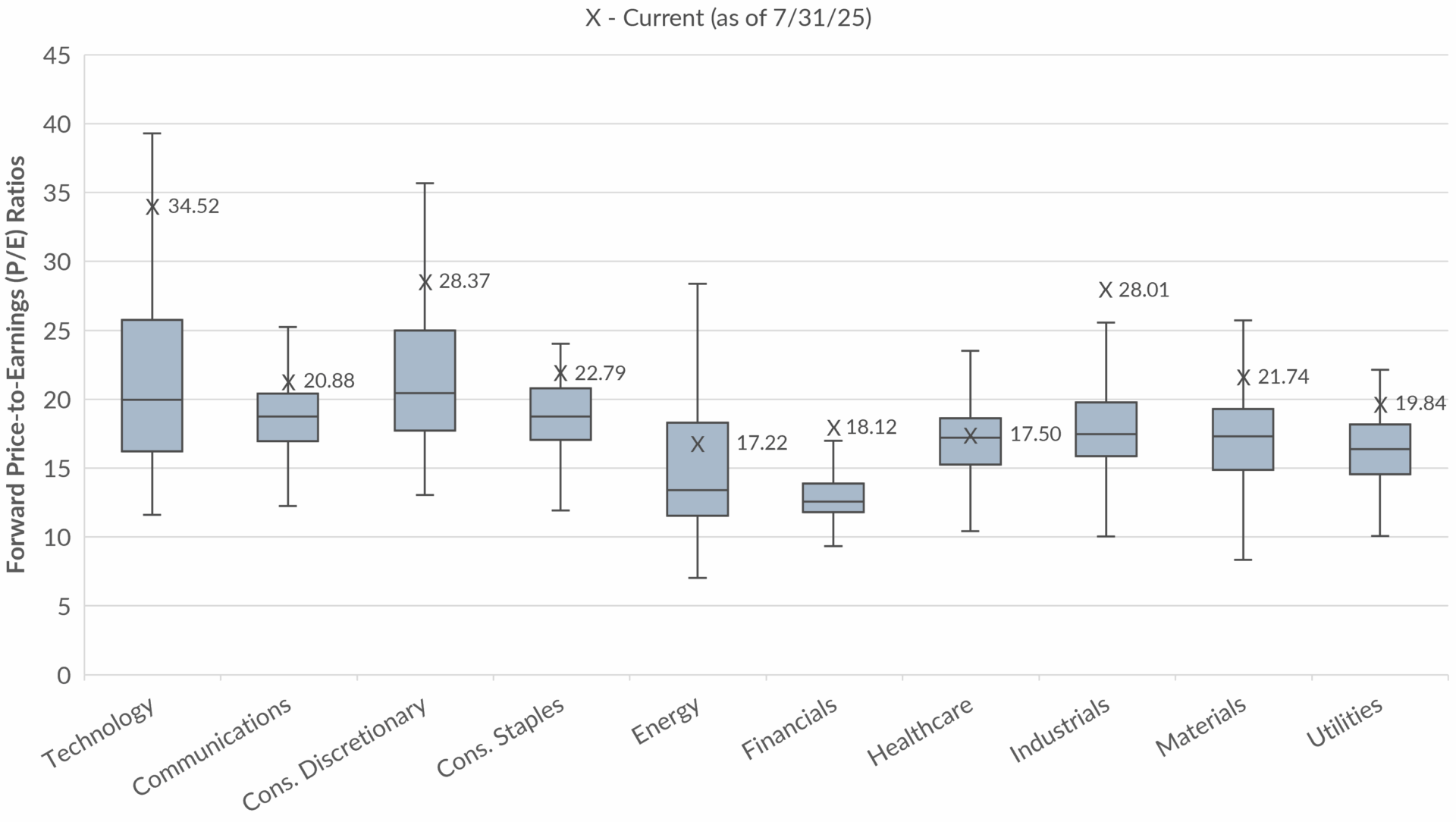
Source: Bloomberg Finance, L.P.
While high prices in and of themselves are not a worry – after all, in a bull market we expect stocks to make new highs every few days – the assumptions of January are top of mind again. The tariff rates that were negotiating ploys a few months ago, are emerging as permanently higher tariff levels as “deals” are reached. While the exact distribution method of tariffs through the economy isn’t known, we do know that it will be reflected as increased costs to businesses and consumers – meaning we should expect slower revenue growth – not the broad acceleration baked into stock prices.
Tariff revenues have already started to flow into the U.S. Treasury. This should offset some of the revenue losses from tax cuts next year. Even so, this revenue will not fully offset the expected growth in outlays. Large fiscal deficits and a growing national debt are likely to be permanent features. So even though a slowing economy, with a weakening labor market and moderate inflationary pressures may enable the Federal Reserve to lower short-term interest rates, long-term interest rates will continue to reflect the decreasing creditworthiness of the U.S. government.
In conclusion, we have made a round trip in U.S. stock prices from the highs of February to the April lows, and back to July highs. At the same time, none of our concerns expressed in January’s Forecast Report have materially changed. Concord’s general asset allocation ideas remain unchanged: diversify internationally, keep bond portfolios short duration and high quality, and rebalance to ensure your stock/bond mix reflects your risk tolerance and will enable you to buy low and sell high. With U.S. stock prices at or near all-time highs on an absolute and relative basis, rebalancing makes sense to us.
Author

Gary Aiken, Chief Investment Officer
Gary Aiken is the Chief Investment Officer for Concord Asset Management and is responsible for macroeconomic analysis, asset allocation, and security selection, as well as trading and investment operations.
Gary has over 23 years of investment experience and holds an undergraduate degree in economics from the University of Maryland and an MBA from The George Washington University School of Business.
—
Please remember that past performance may not be indicative of future results. Different types of investments involve varying degrees of risk, and there can be no assurance that the future performance of any specific investment, investment strategy, or product (including the investments and/or investment strategies recommended or undertaken by Concord Asset Management, or any non-investment related content, made reference to directly or indirectly in this article will be profitable, equal any corresponding indicated historical performance level(s), be suitable for your portfolio or individual situation, or prove successful. This material may contain assumptions that are “forward-looking statements,” which are based on current assumptions of future events. Actual events are difficult to predict and may differ from those assumed. There can be no assurance that forward-looking statements will materialize or that actual results will not be materially different from those described here. Forward Price-to-Earnings Ratios (P/E) are calculated by dividing the current share price of a company or index by the estimated future earnings per share (EPS) of that same company or index. Due to various factors, including changing market conditions and/or applicable laws, the content may no longer be reflective of current opinions or positions. Moreover, you should not assume that any discussion or information contained in this article serves as the receipt of, or as a substitute for, personalized investment advice from Concord Asset Management. To the extent that a reader has any questions regarding the applicability of any specific issue discussed above to his/her individual situation, he/she is encouraged to consult with the professional advisor of his/her choosing. Concord Asset Management is neither a law firm, nor a certified public accounting firm, and no portion of this content should be construed as legal or accounting advice. A copy of Concord Asset Management’ current written disclosure Brochure discussing our advisory services and fees is available upon request or at www.concordassetmgmt.com. Please Note: If you are a Concord Asset Management or Concord Wealth Partners client, please remember to contact the firm in writing, if there are any changes in your personal/financial situation or investment objectives for the purpose of reviewing, evaluating, and/or revising our previous recommendations and/or services, or if you would like to impose, add, or to modify any reasonable restrictions to our investment advisory services. Concord Asset Management and Concord Wealth Partners shall continue to rely on the accuracy of information that you have provided. Please Note: If you are a Concord Asset Management or Concord Wealth Partners client, please advise us if you have not been receiving account statements (at least quarterly) from the account custodian.