
By Gary Aiken | September 4, 2025
This time last year, we were preparing for the first Fed Funds interest rate cuts since April 2020. The Federal Reserve Board was reluctant to proclaim “Mission Accomplished” as the inflation rate remained stubbornly above its 2% target but could no longer ignore that their monetary policy was having a corollary, negative effect on the labor market. It was time to cut rates.
I argued in these pages that IF the Federal Reserve was serious about driving inflation below its 2% target, that it would be very difficult to imagine a prolonged easing cycle. After all, Chairman Powell had proclaimed in his August 2022 Jackson Hole speech that we should prepare for “pain.” Markets interpreted that meant the Fed was willing to risk a recession and a significant rise in the unemployment rate to quash inflation.
But, while investors experienced a painful 2022, unemployment did not rise significantly. In August 2023, a year into the tightening cycle, weekly jobless claims were on average about the same as pre-pandemic (and about the same on average today, too). Continuing claims moved back to their pre-pandemic level of approximately 1.8 million (we’re just shy of 2 million today). The unemployment rate today at 4.2% is not significantly higher than the pre-pandemic level of 3.5% and the same as when the Fed started cutting rates a year ago.
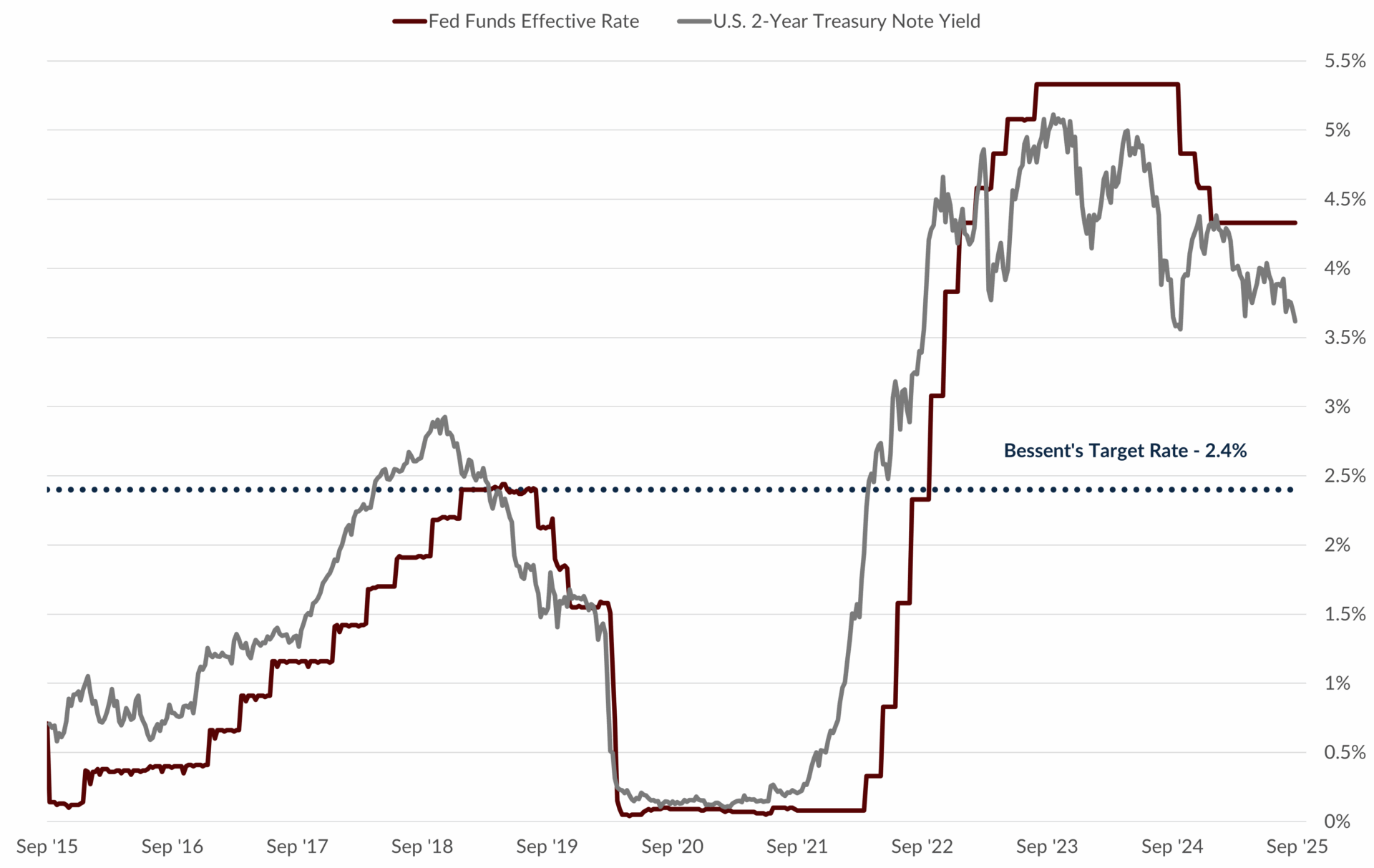
The economy today, while some things have changed, doesn’t seem terribly different from what it was a year ago or than it was before the pandemic. So, Treasury Secretary Bessent argues, it should follow that we ought to have the same interest rate structure today as we did before the pandemic. That means, in his opinion, short-term interest rates should be 150 to 175 basis points (a basis point is 1/100 of a percentage point) lower, i.e., the Fed Funds interest rate should decline to roughly 2.5% from 4.3% over a relatively short period.
Fed Funds & Secretary Bessent’s Target
Source: Bloomberg Finance, L.P.
Financial media and political detractors make the following arguments against. Lowering interest rates dramatically doesn’t make sense when inflation is running above the Fed’s target. The labor market seems solid; an interest rate cut doesn’t seem necessary if the economy is doing fine. Cutting rates will spur economic growth, and combined with tariffs, will lead to more inflation, not less.
I’ll add another point. The One Big Beautiful Bill is designed to engineer considerable business investment and consumer spending in 2026. That spending in a tariff-induced, supply constrained market will lead again to pricing power by companies – who we know from our experience in 2021 will exploit that impulse profitably.
That doesn’t mean that Bessent is wrong, though. There are significant counterweights on the demand side. While legal immigration continues, the demand coming from millions of new undocumented immigrants every year has stopped. Immigration muddied the waters in many population data sets, including survey-based measures of employment. Large negative job number revisions came this summer, and many economists expect further downward revisions painting a less than rosy portrait of jobs in America. That revised data would be in line with bank data showing significantly higher delinquencies in credit cards and other loan types and retail data showing consumers looking for deals from white-labeled products at the grocery store to off-brand back to school clothing sales.
It seems investors cannot avoid politics. The Federal Reserve has been political or is at least perceived by the market to be political – and the second may be worse than the first. Since the Great Financial Crisis of 2008-09, the Fed has come to the rescue of the economy (and the politicians) by making monetary policy that amplifies or excuses bad policy by the Congress and White House. And before you ask, I can give bi-partisan examples. No one is blameless. When the Fed loses credibility in the eyes of its defenders, it is no longer impervious to more overt efforts to diminish its independence.
Treasury Secretary Bessent is going to win this battle. The White House is going all out with Federal Reserve governors leaving early of their own volition (Kugler) or being forced out (Cook). With its appointees in place, the Trump administration will be able to nominate Federal Reserve Bank presidents who are amenable to Bessent’s opinions. That isn’t to say they won’t be qualified and credentialled economists, it’s just that their likely interpretation of data will lead to similar conclusions that benefit the White House’s aims.
And the White House’s aims are not bad for investors. Lower rates will, as they almost always have, lead to more economic activity. More economic activity will lead to higher corporate revenue and profits and to more tax revenue and lower deficits. It will also lead to slightly more inflation. The dollar should decline, international investments should prosper along with U.S. stocks, and previously unfavored investment sectors may get a second life. In other words, The Grind higher in asset prices persists.
Author

Gary Aiken, Chief Investment Officer
Gary Aiken is the Chief Investment Officer for Concord Asset Management and is responsible for macroeconomic analysis, asset allocation, and security selection, as well as trading and investment operations.
Gary has over 23 years of investment experience and holds an undergraduate degree in economics from the University of Maryland and an MBA from The George Washington University School of Business.
—
Please remember that past performance may not be indicative of future results. Different types of investments involve varying degrees of risk, and there can be no assurance that the future performance of any specific investment, investment strategy, or product (including the investments and/or investment strategies recommended or undertaken by Concord Asset Management, or any non-investment related content, made reference to directly or indirectly in this article will be profitable, equal any corresponding indicated historical performance level(s), be suitable for your portfolio or individual situation, or prove successful. This material may contain assumptions that are “forward-looking statements,” which are based on current assumptions of future events. Actual events are difficult to predict and may differ from those assumed. Due to various factors, including changing market conditions and/or applicable laws, the content may no longer be reflective of current opinions or positions. Moreover, you should not assume that any discussion or information contained in this article serves as the receipt of, or as a substitute for, personalized investment advice from Concord Asset Management. To the extent that a reader has any questions regarding the applicability of any specific issue discussed above to his/her individual situation, he/she is encouraged to consult with the professional advisor of his/her choosing. Concord Asset Management is neither a law firm, nor a certified public accounting firm, and no portion of this content should be construed as legal or accounting advice. A copy of Concord Asset Management’ current written disclosure Brochure discussing our advisory services and fees is available upon request or at www.concordassetmgmt.com. Please Note: If you are a Concord Asset Management or Concord Wealth Partners client, please remember to contact the firm in writing, if there are any changes in your personal/financial situation or investment objectives for the purpose of reviewing, evaluating, and/or revising our previous recommendations and/or services, or if you would like to impose, add, or to modify any reasonable restrictions to our investment advisory services. Concord Asset Management and Concord Wealth Partners shall continue to rely on the accuracy of information that you have provided. Please Note: If you are a Concord Asset Management or Concord Wealth Partners client, please advise us if you have not been receiving account statements (at least quarterly) from the account custodian.