
By Gary Aiken | August 6, 2026
July saw single stock volatility rise to an extreme. In addition, it saw volatility in individual stocks widely dispersed and relatively uncorrelated to the S&P 500 Index. What does that mean? It means two things. First, many individual stocks in the index had wild rides in July, while the market overall didn’t seem to have a particularly interesting month. The S&P 500 Total Return Index was down a whopping 0.06%.
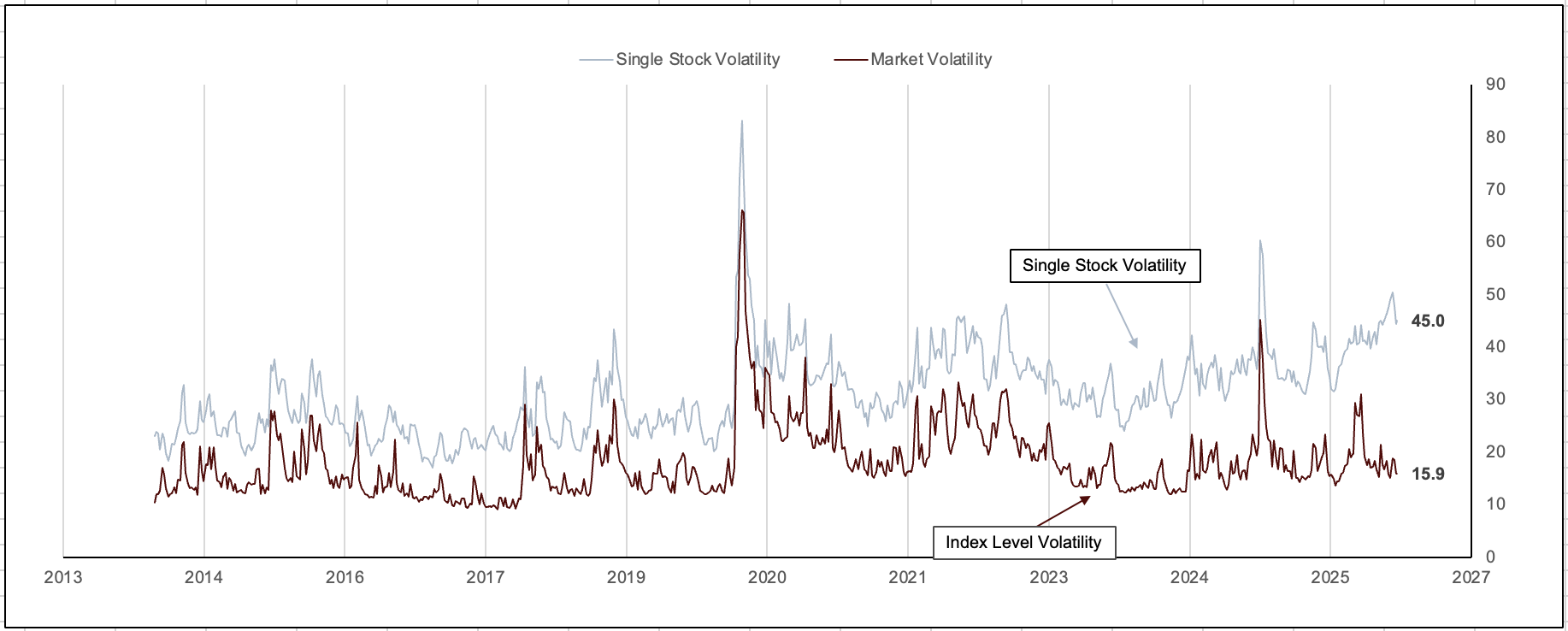
The Chart of the Month shows the VIX (CBOE Volatility Index) and the VIXEQ (CBOE S&P 500 Constituent Volatility Index). The VIXEQ since measurement began in June 2014 has always been higher than the VIX. This makes intuitive sense. Any individual stock is going to be more volatile than a group of stocks. This is how and why diversification works.
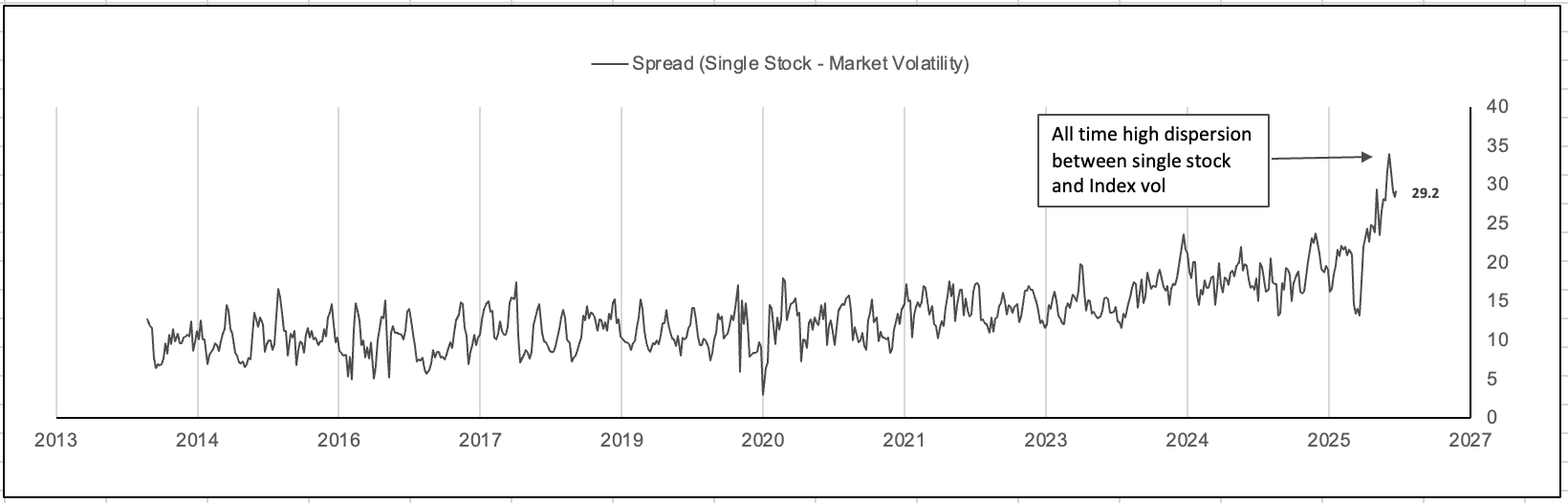
But the difference (spread) between VIXEQ and VIX is also instructive. It tells us when stock correlation is likely to be high or low. The lower the spread, the more the average stock is likely to have volatility like the index. But a high spread means the average stock volatility looks nothing like the market. That’s what happened in July when the spread hit the highest level since measurement began.
Market commentators have given many reasons why they think record dispersion occurred in July. Among these are geopolitics, the Fed, interest rates, changes to the forecast for AI spending, Korean investor stock margin calls, the amount of leverage by individual investors and hedge funds, etc. For me, the cause isn’t the most important thing. What matters is what we do when presented with this historic dispersion.
The Spread Between Single Stock and Index Volatility Hits a Record
July’s excess volatility gives our clients a few opportunities. The opportunity that this month’s commentary will focus on is tax-loss harvesting. We are more than halfway through 2026 and soon enough we’ll be thinking about how to offset capital gains and ordinary income through the realization of losses. In some prior periods, we haven’t had a lot of losses to give. But with this increased single stock volatility comes the opportunity to take some losses as stock variance grows.
Tax-Loss Harvesting (TLH) is the process of identifying positions or tax-lots where shares of stocks you own are trading below your purchase price. Those lots are in an unrealized loss position. If you sell those shares, you will realize the loss and be able to use those losses to offset gains and lower your tax burden in the current year. If you have sufficient losses, you may even be able to carry those losses into the future to offset future capital gains. The downside (besides transferring your paper losses into actual losses) is that now you have cash to put to work.
The second part of TLH is buying some other investment. But what to buy? At Concord, our approach is to buy exchange-traded funds (ETFs). We do this for a couple of reasons. First, the ETFs are identified in advance and put into our trading systems because they have a high allocation to that stock, are generally correlated with that stock’s performance historically, and maintain industry sector exposure. Second, one of the things we talk about to clients is that our stock portfolios benefit not just from picking good ideas but avoiding truly bad ones – to the extent that’s possible. Buying a stock we don’t particularly want to own, just because it’s like one we did want to own isn’t appealing. The ETF gives us temporary exposure without idiosyncratic (single stock) risk – there’s safety in crowds.
The third part of TLH is buying back the original stock after the wash-sale period has ended. The IRS rules that if you sell an investment, you must wait 31 days before you can buy that investment back. Also, the thing you buy in its place can’t be substantially the same as the thing you sell. So, our ETF accomplishes the second part, while not forcing us to take idiosyncratic risks during those 31 days.
For taxable accounts, we offer two flavors of Tax-Loss Harvesting (TLH). One is ad-hoc and the other is what we call “Aggressive” TLH. Ad-hoc is discretionary in nature. We watch our portfolios for opportunities to make TLH trades. Opportunities like when single stock volatility goes higher like during July. This is also appropriate for clients who do not like to see lots of transaction volumes on their monthly statements. Aggressive TLH is more systematic. The frequency of automated TLH is much higher and the threshold for losses to realize in dollars and percentage terms is lower. This doesn’t necessarily mean that you’ll have more losses, but it does mean that if those losses are available, they will be realized for your tax benefit.
Each client’s needs and preferences are different. Ask your Concord Wealth Partners advisor about your situation and which version is right for you. No one likes to take losses, but if you’re an investor in the stock market, you’re going to lose sometimes. Luckily, you can use those losses to offset gains or other income and lessen that other thing we hate but can’t avoid – taxes!
Author

Gary Aiken
Chief Investment Officer
Concord Asset Management
Gary Aiken is the Chief Investment Officer for Concord Asset Management and is responsible for macroeconomic analysis, asset allocation, and security selection, as well as trading and investment operations.
Gary has over 23 years of investment experience and holds an undergraduate degree in economics from the University of Maryland and an MBA from The George Washington University School of Business.
—
Please remember that past performance may not be indicative of future results. Different types of investments involve varying degrees of risk, and there can be no assurance that the future performance of any specific investment, investment strategy, or product, including the investments and/or investment strategies recommended or undertaken by Concord Asset Management, or any non-investment related content made reference to directly or indirectly in this article, will be profitable, equal any corresponding indicated historical performance level(s), be suitable for your portfolio or individual situation, or prove successful. This content is provided for informational and educational purposes only and should not be construed as personalized investment, legal, tax, or accounting advice. Any forward-looking statements, opinions, or projections expressed herein are based on information available at the time of publication and are not guarantees, predictions, or assurances of future events, performance, or results. Actual outcomes may differ materially due to market conditions, economic developments, regulatory changes, changes in applicable laws or regulations, and other factors.
Due to various factors, including changing market conditions and/or applicable laws, the content may no longer be reflective of current opinions or positions. Moreover, you should not assume that any discussion or information contained in this article serves as the receipt of, or as a substitute for, personalized investment advice from Concord Asset Management. To the extent that a reader has any questions regarding the applicability of any specific issue discussed above to his/her individual situation, he/she is encouraged to consult with the professional advisor of his/her choosing.
Concord Asset Management is neither a law firm nor a certified public accounting firm, and no portion of this content should be construed as legal or accounting advice. A copy of Concord Asset Management’s current written disclosure Brochure discussing our advisory services and fees is available upon request or at www.concordassetmgmt.com. Please Note: If you are a Concord Asset Management or Concord Wealth Partners client, please remember to contact the firm in writing if there are any changes in your personal/financial situation or investment objectives for the purpose of reviewing, evaluating, and/or revising our previous recommendations and/or services, or if you would like to impose, add, or modify any reasonable restrictions to our investment advisory services. Concord Asset Management and Concord Wealth Partners shall continue to rely on the accuracy of information that you have provided.
Please Note: If you are a Concord Asset Management or Concord Wealth Partners client, please advise us if you have not been receiving account statements, at least quarterly, from the account custodian.