
By Gary Aiken | November 5, 2026
It’s been a rough earnings season for the owners of information technology stocks and industrial stocks tied to the artificial intelligence (AI) boom. While there are certainly some technical, seasonal, and idiosyncratic explanations, as in many cases, simpler is better. The way Concord has constructed its framework around AI risk has been the subject of recent Insight pieces and episodes of our excellent podcast “Built to Last.” There was an Irish pub near my home in Falls Church called the Four Provinces – the Four P’s, as we used to call it. Four P’s may also be a shorthand to contextualize the selloff and maybe find value for the future.
The first “P” is Power. The technology sphere has taken to explaining capacity not in megahertz or terabytes, but in megawatts. Datacenters are filled not with humans (although there’s still a contingent of us), but with servers. These servers contain circuit boards filled with microchips for computing and memory, copper, gold and advanced optical wiring, power supplies and cooling mechanisms. Increasing compute devours and requires more memory and storage. These server farms need electricity to run. And as they power through tasks, they generate heat and need to be cooled – and that takes electricity, too. The generation, transmission, and storage of electricity to power the expanding number of datacenters is not keeping pace with demand. Further, this isn’t the type of demand where just because the price goes up, supply magically appears.
Supply is constrained – it’s a “bottleneck.” Without a magical ramp for capacity, a bottleneck constraint remains. The variable that solves this equation is time. Remember that. It will be important later.
The second and third “P’s” are Permits and Politics. If you want to build a deck or remodel your kitchen, you need a permit. If you live in a neighborhood with an HOA, you might need their permission, too. If you wanted to build a new building or subdivision, it would require environmental studies and zoning approvals and probably go through some local government approval process. Imagine you had made some political enemies along the way – even if only they knew you were their enemy. They show up, they make political donations, they make speeches and ads and try to convince elected officials that approving your new datacenter would be hazardous to their future electoral prospects. That approval process might get bogged down. It might get much, much slower. Days turn into weeks and months. Even if you have the financing in place, the components ordered, and the contractors ready to go, you can’t break ground without those approvals. Permits and politics add time before you can start, and completion times get longer, too.
The fourth “P” is the Price of Money. While you were waiting for power and permits, a second war broke out in a region of the world that supplies a huge amount of oil, natural gas, and derivatives like fertilizer and refined fuels. Inflation starts to rise and central banks around the world start reacting – they start raising interest rates. Some of your competitors have also borrowed too much money – at least market participants think so and the credit agencies tend to agree. Unfortunately, your price to borrow – your interest rate – goes up, too. Interest rates on shorter-term loans have increased from 4% to 8% for the best borrowers and are now into the low double digits for the average borrower. Not terrible in the long run; after all, you penciled in a number like that in your pro forma and the project still makes sense.
Your shareholders have choices, though. The value of a business is the present value of future cash flows discounted at some interest rate. Cash flows that are further away in time are not worth as much as cash flows nearer to us. Power and permit constraints are pushing cash flow further into the future while interest rates are going up today. Power and permit timelines are also becoming increasingly less certain and therefore riskier, so maybe we will increase our discount rate a little more to account for that execution risk.
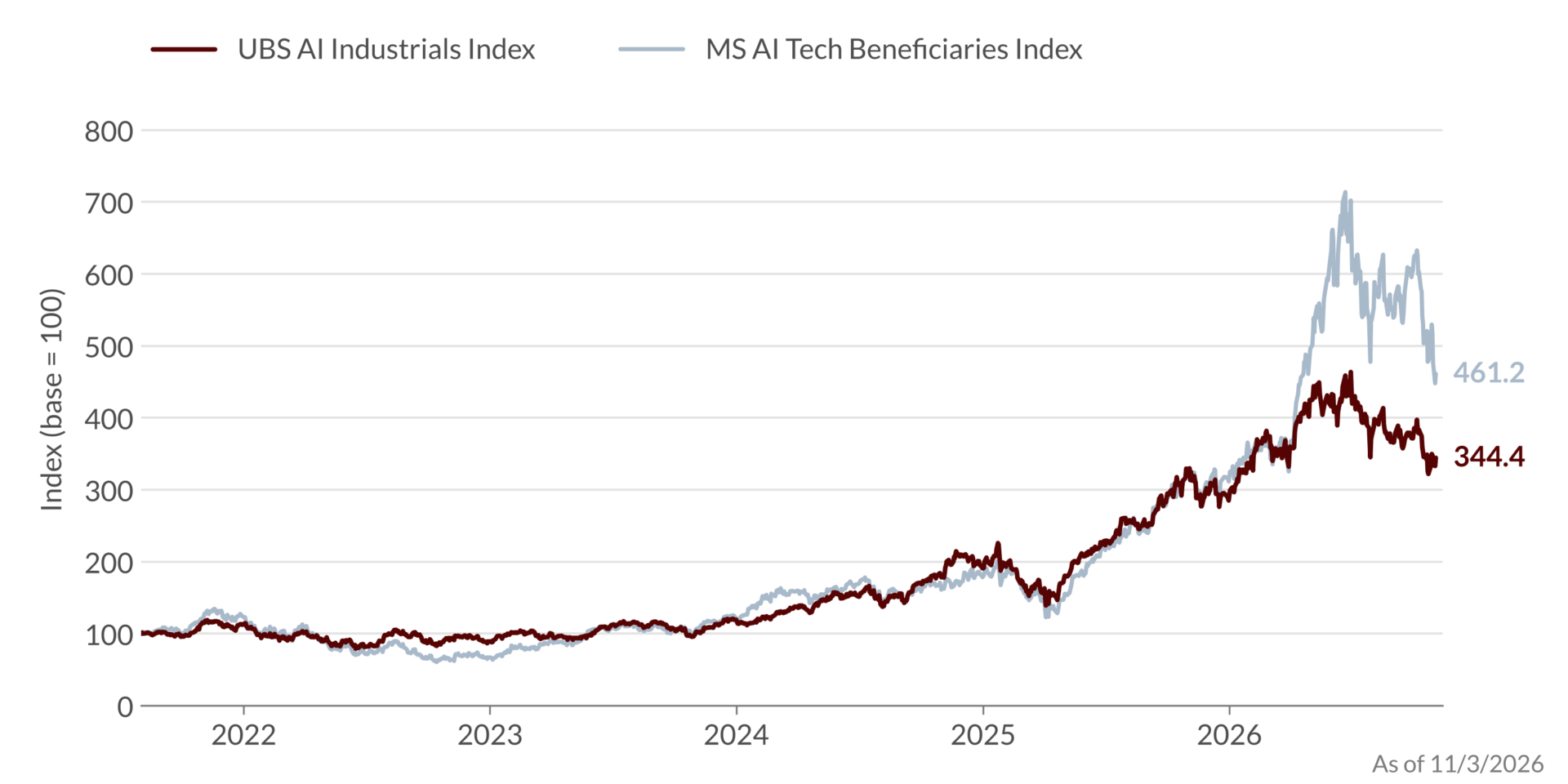
Presented with these new facts, it’s not hard to see how over the course of 2026, valuations of every company in the AI datacenter buildout ecosystem have fallen into a bear market. The UBS AI Industrials Index is down 27% since its highs in early July. This custom index includes the companies involved in building, powering, cooling, and providing electrical infrastructure at the datacenter and to the grid. The Morgan Stanley AI Tech Beneficiaries Index is down about 35% over the same time frame. This basket of stocks includes firms across semiconductor and semi equipment, optical networking, and storage.
Tech Stocks Have Declined Since Their June Highs
Source: Bloomberg Finance, LP
And yet, virtually every company in each of these indexes is profitable and is likely to generate higher revenue and greater profits next year than it did this year. How is it possible that a company is likely to make more money in the future, but its stock price goes down?
Market expectations were too high. Microsoft, Oracle, Google, and Amazon all reported in the past two weeks that they are not increasing their scheduled capital expenditures for next year. It’s not because they don’t want to. Each has shown that the money they’ve invested in datacenter buildout has a high return on invested capital.
My contention is that it’s the Four P’s. Power, Permits, and Politics are timing bottlenecks stretching cash flows further into the future and making them less certain. The Price of Money requires a new calculation resulting in lower valuations. There’s still an AI competition, but it’s no longer a game of leapfrog to the top. Like the Tortoise and the Hare, maybe slow and steady wins the race. In that environment, buying the stocks of companies well off their recent highs could make sense.
Author

Gary Aiken
Chief Investment Officer
Concord Asset Management
Gary Aiken is the Chief Investment Officer for Concord Asset Management and is responsible for macroeconomic analysis, asset allocation, and security selection, as well as trading and investment operations.
Gary has over 23 years of investment experience and holds an undergraduate degree in economics from the University of Maryland and an MBA from The George Washington University School of Business.
—
Please remember that past performance may not be indicative of future results. Different types of investments involve varying degrees of risk, and there can be no assurance that the future performance of any specific investment, investment strategy, or product (including the investments and/or investment strategies recommended or undertaken by Concord Asset Management, or any non-investment related content, made reference to directly or indirectly in this article will be profitable, equal any corresponding indicated historical performance level(s), be suitable for your portfolio or individual situation, or prove successful. Due to various factors, including changing market conditions and/or applicable laws, the content may no longer be reflective of current opinions or positions. Moreover, you should not assume that any discussion or information contained in this article serves as the receipt of, or as a substitute for, personalized investment advice from Concord Asset Management. To the extent that a reader has any questions regarding the applicability of any specific issue discussed above to his/her individual situation, he/she is encouraged to consult with the professional advisor of his/her choosing.
The companies mentioned are for informational purposes only. It should not be considered a solicitation for the purchase or sale of any specific securities. Investing involves risks, and investment decisions should be based on your own goals, time horizon, and tolerance for risk. The return and principal value of investments will fluctuate as market conditions change. When sold, investments may be worth more or less than their original cost. The forecasts or forward-looking statements are based on assumptions, may not materialize, and are subject to revision without notice. The market indexes discussed are unmanaged and generally considered representative of their respective markets. Index performance is not indicative of the past performance of a particular investment. Indexes do not incur management fees, costs, and expenses. Individuals cannot directly invest in unmanaged indexes. The Dow Jones Industrial Average is an unmanaged index that is generally considered representative of large-capitalization companies on the U.S. stock market. Nasdaq Composite is an index of the common stocks and similar securities listed on the NASDAQ stock market and is considered a broad indicator of the performance of technology and growth companies. The MSCI EAFE Index was created by Morgan Stanley Capital International (MSCI) and serves as a benchmark of the performance of major international equity markets, as represented by 21 major MSCI indexes from Europe, Australia, and Southeast Asia. The S&P 500 Composite Index is an unmanaged group of securities that are considered to be representative of the stock market in general. U.S. Treasury Notes are guaranteed by the federal government as to the timely payment of principal and interest. However, if you sell a Treasury Note prior to maturity, it may be worth more or less than the original price paid. Fixed income investments are subject to various risks, including changes in interest rates, credit quality, inflation risk, market valuations, prepayments, corporate events, tax ramifications, and other factors. International investments carry additional risks, which include differences in financial reporting standards, currency exchange rates, political risks unique to a specific country, foreign taxes and regulations, and the potential for illiquid markets. These factors may result in greater share price volatility. Please consult your financial professional for additional information.
Concord Asset Management is neither a law firm, nor a certified public accounting firm, and no portion of the content should be construed as legal or accounting advice. A copy of Concord Asset Management’ current written disclosure Brochure discussing our advisory services and fees is available upon request or at https://concordwealthpartners.com/.
Concord Asset Management, LLC (“CAM”) and Concord Wealth Partners, LLC (“CWP”) are affiliated investment advisers under common control and share certain supervised persons. CAM provides investment sub-advisory services to CWP.
Please Note: If you are a Concord Asset Management or Concord Wealth Partners client, please remember to contact the firm in writing, if there are any changes in your personal/financial situation or investment objectives for the purpose of reviewing, evaluating, and/or revising our previous recommendations and/or services, or if you would like to impose, add, or to modify any reasonable restrictions to our investment advisory services. Concord Asset Management and Concord Wealth Partners shall continue to rely on the accuracy of information that you have provided.
Please Note: If you are a Concord Asset Management or Concord Wealth Partners client, please advise us if you have not been receiving account statements (at least quarterly) from the account custodian.